I ran restaurants for fifteen years before I touched a line of product strategy, so let me say this as an operator: the question isn't whether AI can act on your behalf. It obviously can. The question is which actions you'd want back the morning after — and there is no undo button on a refund, a deleted reservation, or a public reply posted under your name.
Most AI tools answer this question with a slider: 'autonomy level — low, medium, high.' That's the wrong abstraction. Risk isn't a dial; it's a line. Some actions are fine to run automatically all day. Others should wait for a human tap, every single time, no matter how good the AI gets. This post is about where that line sits, and why we built it into Nuxa as law rather than a setting.
What is the approval line?
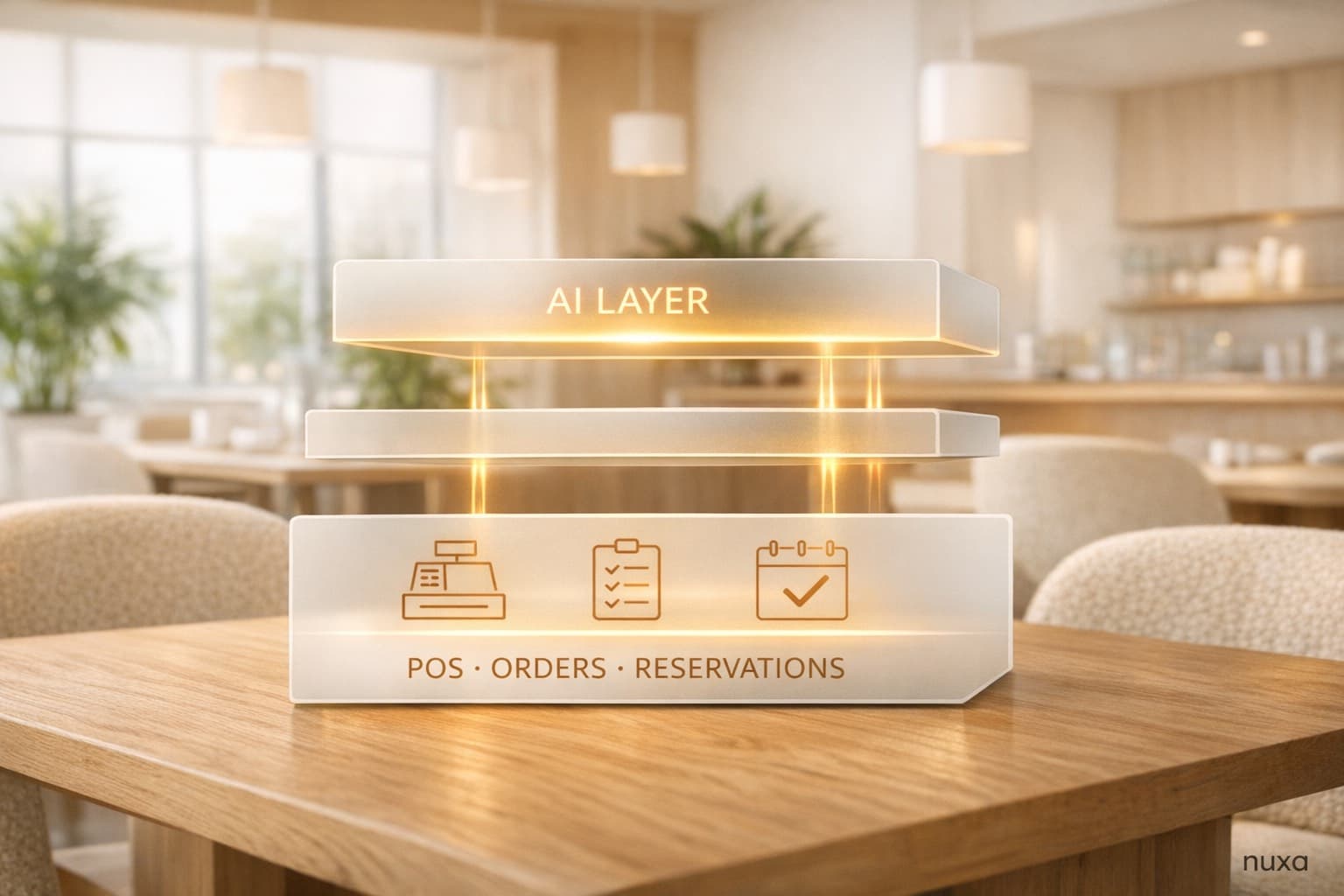
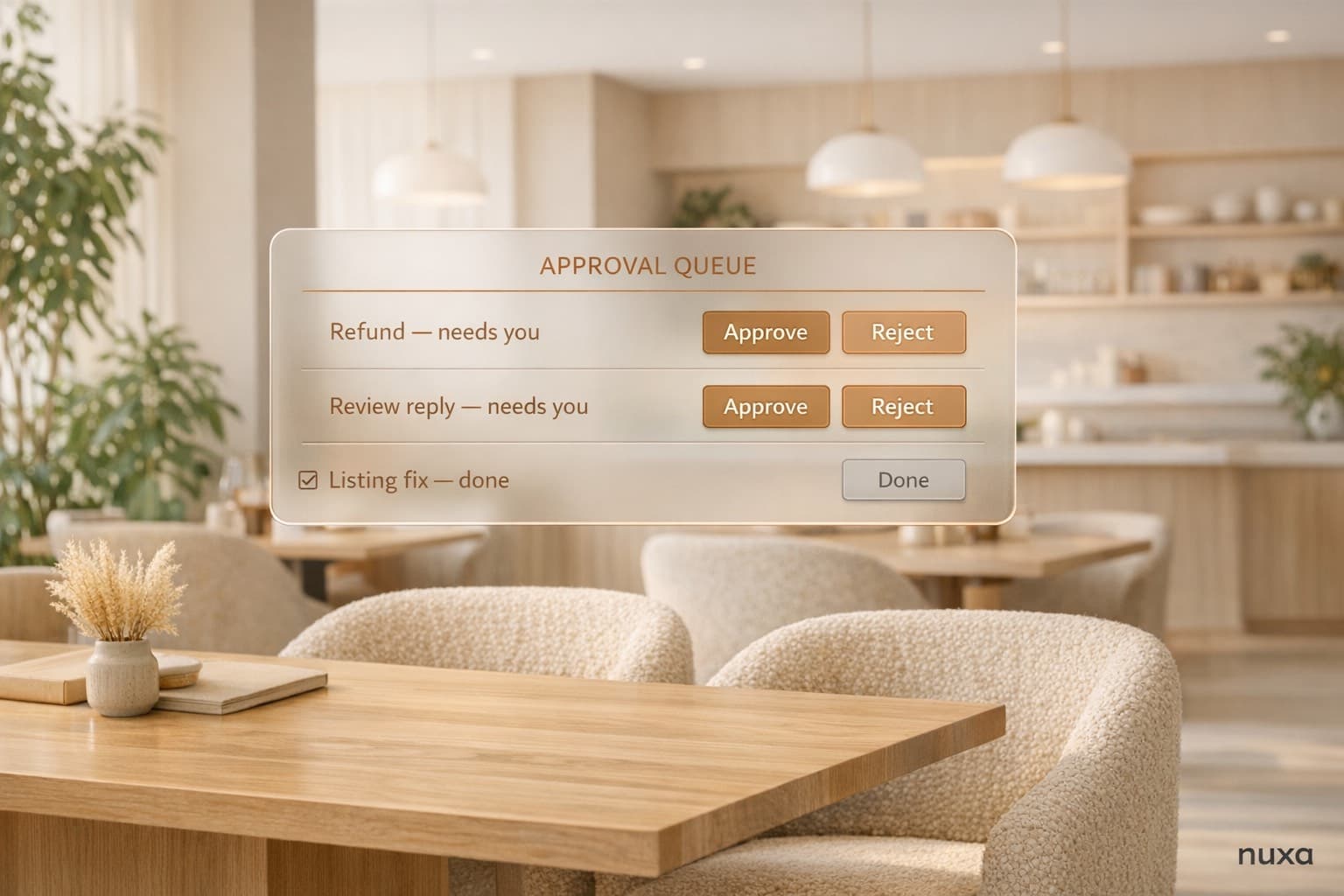
The approval line is the boundary between actions an AI employee may complete on its own and actions that suspend and wait for the owner. On the safe side: reading your POS, analyzing reviews, drafting replies, preparing reports, ranking what matters this morning. On the other side: anything that crosses into money, permanence, or your name in public. Cross the line and the action pauses as a pending approval — your AI team prepares the work, but you fire the shot.
Which decisions should AI never make alone?
We sort everything an AI employee can do into three risk classes that always require approval:
- Liability — anything touching money or legal exposure. Refunds, comps, discounts honored after the fact, anything fiscal. A wrong refund isn't just lost margin; it's a bookkeeping discrepancy your accountant finds in March.
- Irreversible — deletions, cancellations, anything you can't take back. A cancelled reservation can't be un-cancelled after the guest has rebooked elsewhere.
- Outward — anything published under your brand. Review replies, social posts, website changes, customer emails. Once it's public, it's screenshot-able forever.
Everything else — internal analysis, drafts, the daily brief, report narration — runs automatically. That's the point: the line lets the safe 90% run at full speed precisely because the risky 10% can't slip through with it.
Why do refunds stay approval-gated forever?
Plenty of AI vendors will tell you the gates loosen as the system 'earns trust.' We made the opposite promise, in writing: refunds and money movement stay approval-gated permanently. No autonomy tier, no track record, no future model upgrade ever removes that gate.
An AI that's right 99% of the time about refunds is wrong about money four times a year. The approval tap costs you three seconds. The wrong refund costs you a reconciliation headache and a little bit of trust in the whole system.
There's a deeper reason too. The moment money can move without a human, your incentive flips from 'use the AI more' to 'audit the AI constantly.' A permanent gate keeps the relationship honest: the AI proposes, you dispose, and you never have to wonder what it did with your cash drawer while you slept.
Doesn't all this approving slow me down?
Less than you'd think, because the work arrives finished. Grace doesn't ask you to write a reply to the angry two-star from last night — she hands you a complete draft, with the customer's actual order cited (cite-or-die means every fact in it traces to a source), and one approve button. Your job shrinks from 'compose a diplomatic paragraph at 7am' to 'read, nod, tap.' Owners on Nuxa typically clear a morning's pending approvals from the daily brief at nuxa.ai/daily-brief in under two minutes, coffee in hand.
Compare that with the generic-assistant workflow — paste the review into ChatGPT, check the draft for invented facts yourself, copy it into Google, repeat — and the gated version is both faster and safer. Approval isn't friction added to automation. It's the thing that makes full automation of everything else acceptable.
How the approval line shows up in Nuxa
Every tool an AI employee can use is classified before it ships. If its effect is liability, irreversible, or outward, it carries a mandatory approval flag — the agent literally cannot complete the action; it suspends into your pending queue. Each approval (and each rejection) lands in the audit log with who approved, when, and what was done, so there's a paper trail your accountant and your future self can both read.
And your decisions teach the system. Every accepted and rejected draft is recorded, so Grace's next draft sounds a little more like you. The approval line isn't just a brake — it's the steering wheel. The full guardrail model, including the risk classes and the permanent refund gate, is laid out at nuxa.ai/trust. Every plan at nuxa.ai/pricing — $99, $299, and $499 per location — includes unlimited approvals, because safety was never going to be the upsell.