There's a pitch every restaurant owner has heard by now: "Throw out your point of sale, your ordering system, your reservation book — our AI-native platform replaces all of it." It's a seductive pitch. It's also, for most restaurants, a terrible trade. This post explains why Nuxa made the opposite bet: instead of replacing your operational stack, our AI employees connect to the POS you already run, reading it as the system of record — own-stack where it counts, open by design everywhere else. Our founder, Bhagwati Bhushan Mishra, spent years building restaurant operations software before Nuxa existed, which is exactly why we know the data layer this well.
That origin story matters more than it sounds. You can read the long version in our manifesto (https://nuxa.ai/manifesto), but the short version is: we didn't bolt AI onto someone else's data through a rate-limited API. We built the AI on the system of record itself.
Why is rip-and-replace the wrong move for restaurant AI?
A POS migration is one of the most disruptive things a restaurant can do. Staff retraining, menu re-entry, payment reconfiguration, a week of fumbled tickets during your busiest service. Asking an owner to do all that as the entry fee for AI is backwards — you're putting the riskiest, lowest-AI part of the project first.
- The POS is a solved problem. Taking orders, splitting checks, firing tickets to the kitchen — this is mature software. AI adds almost nothing to the transaction itself.
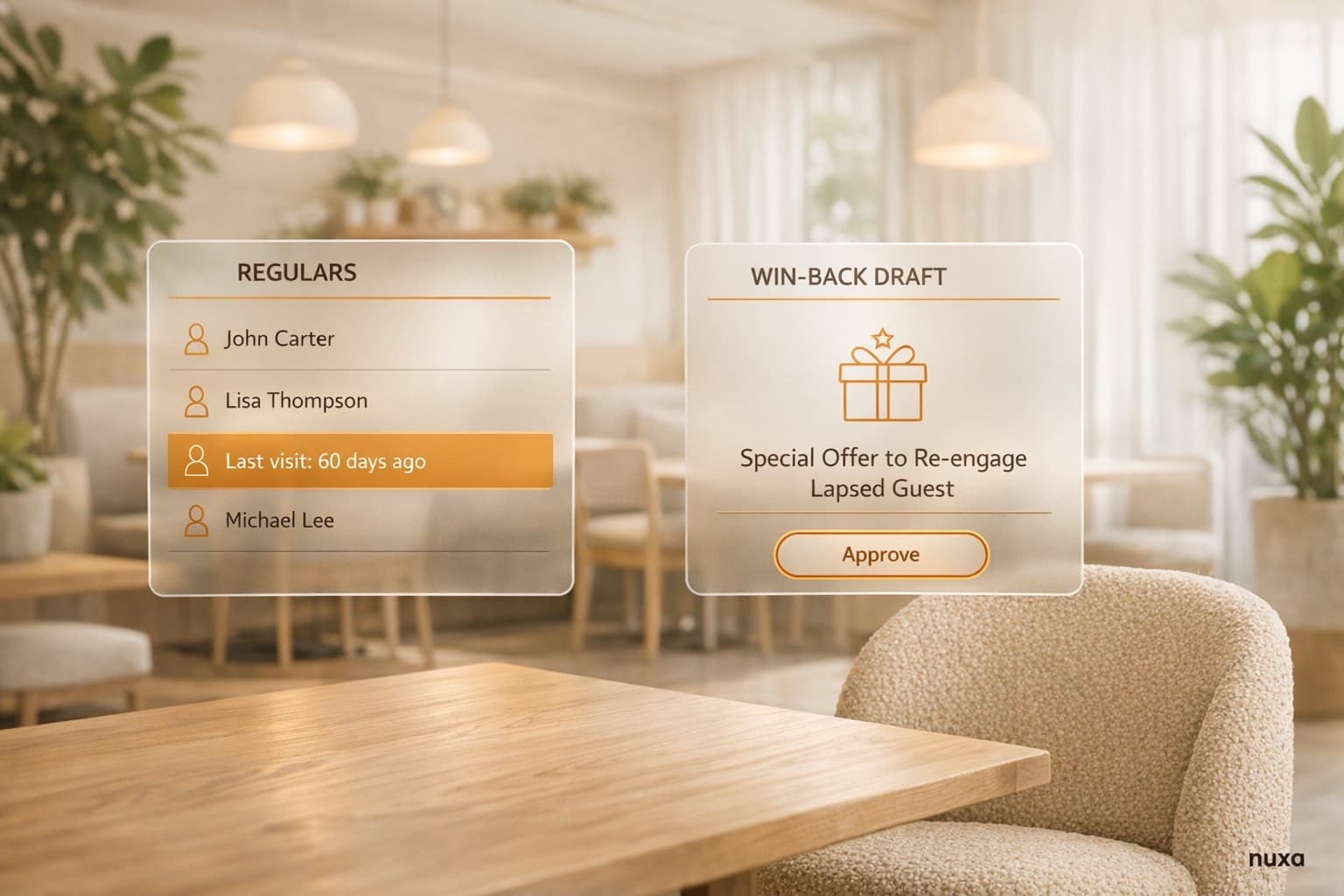
- The unsolved problem is everything around the transaction: who replied to last night's reviews, which regular hasn't been in for 60 days, what to prep before Friday. That's where AI earns its keep — and it needs the POS data, not the POS job.
- Replacing the system of record to get AI is like rebuilding your kitchen to get a better menu. The menu was never blocked by the kitchen.
What does "AI built on the POS" actually unlock?
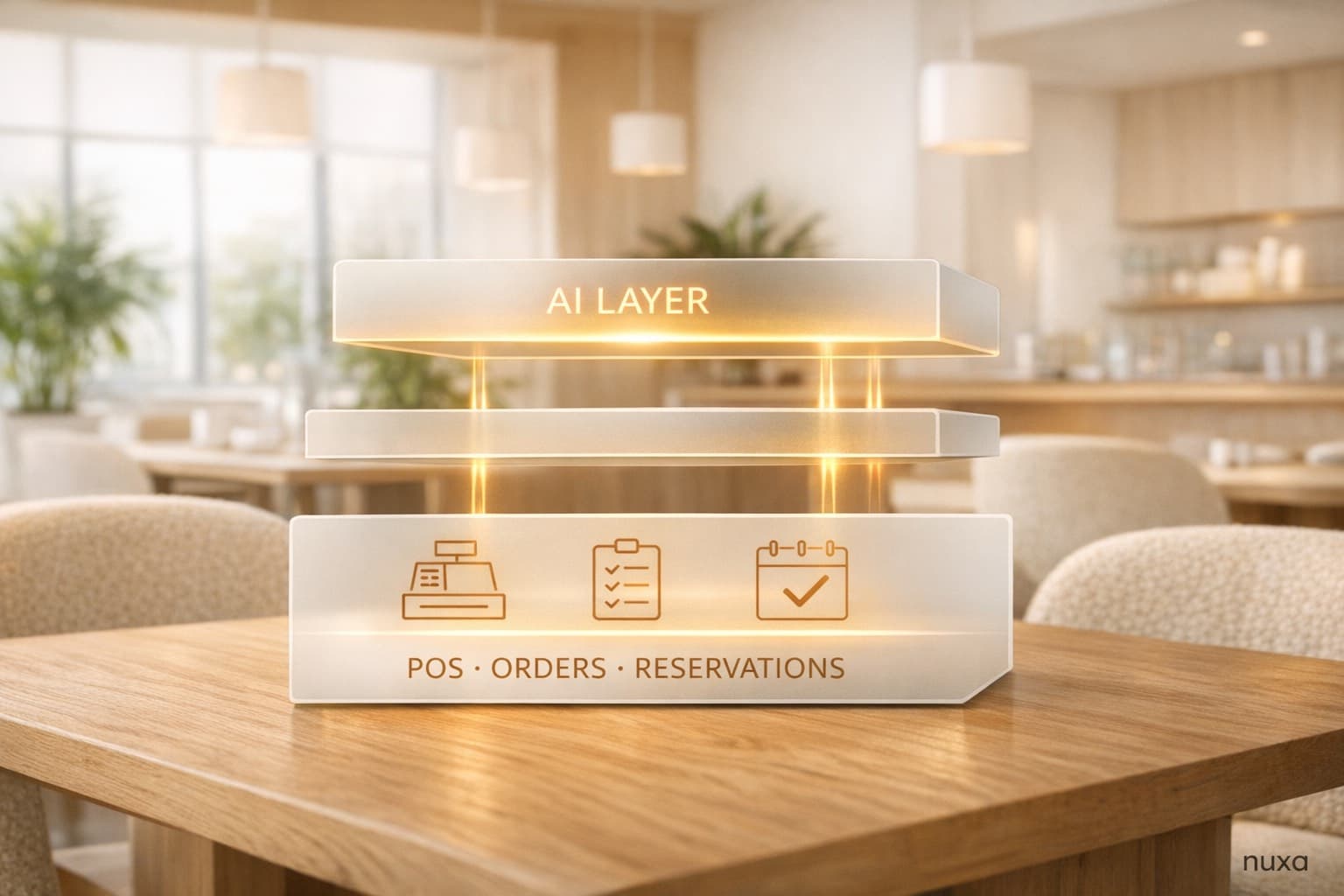
Everything interesting about Nuxa's AI employees comes from one property: they read real operational data at the source. Orders, items, timing, payments, reservations, customer history — live, complete, not a nightly CSV export through a third-party connector.
- Dash builds your Daily Brief (https://nuxa.ai/daily-brief) from actual revenue and order flow — last night's numbers against your own baseline, not industry averages.
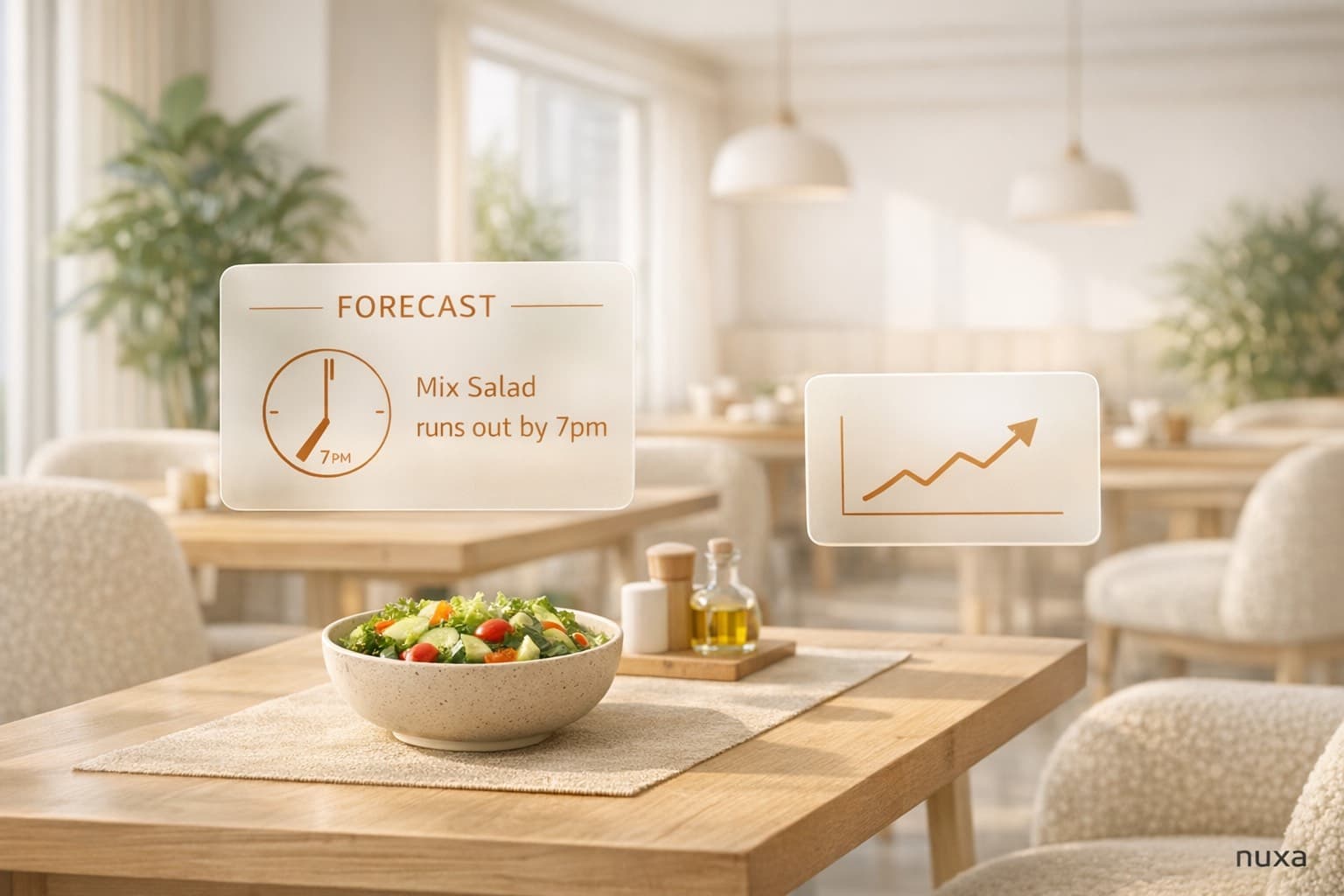
- Atlas can anticipate instead of report: "at the current order rate, you'll run out of Mix Salad by 7pm" is only possible when the AI sees orders as they happen. We unpack that in the anticipation vs. reporting post (https://nuxa.ai/blog/anticipation-vs-reporting-restaurant-ai).
- Churn detection works on real visit history: the regular who quietly stopped coming is visible in the order data months before they leave a bad review — or worse, leave silently (https://nuxa.ai/blog/restaurant-churn-alerts-lost-regulars).
- Grace's review replies can cite facts — the actual dish ordered, the actual visit date — because the source of truth is in the same system. That's what makes cite-or-die enforceable rather than aspirational.
An AI that reads your POS through a third-party export is describing your restaurant from photographs. An AI that runs on the POS is standing in the room.
Doesn't deep access make the AI more dangerous?
It would, if access meant permission. It doesn't. Nuxa's architecture separates what the AI can see from what it can do, and the doing side is locked down harder than any integration vendor's: every fact must be cited to its source, every risky action — anything touching money, anything irreversible, anything published under your name — stops at the approval line for a human decision, and refunds are approval-gated permanently with no override tier. Every action and every AI call is metered and written to an audit log with a hard daily ceiling.
And one line we treat as untouchable: AI never acts on fiscally or tax-relevant operations. The compliance machinery of the POS is read-only territory, forever. The full architecture is documented on the trust page (https://nuxa.ai/trust).
What if I want to keep my current POS?
The honest answer: that's the design. Nuxa owns your website, ordering, and marketing, and connects to the POS you already run — so the AI on top of it can be this good, with no seams in the data. If you're evaluating a stack change anyway (and many independents are, with legacy POS contracts rolling over), deciding on your operational platform and your AI team together is the strongest version of that move: the platform and the AI that runs on it, working as one.
If you're happy with your current stack, fair — bookmark this for contract-renewal season. But run the comparison honestly: an AI bolted onto your stack through exports will always be reporting on yesterday. An AI built into the stack works your restaurant in real time, with ten employees — Grace on reviews, Dash on the brief, Atlas on listings and anticipation, Ink on content, Vibe on social, Pulse on ops, Host on ordering, Quill on guest retention, Ledger on financials, and Sage on menu intelligence — for $99, $299, or $499 a month (https://nuxa.ai/pricing). That's less than one shift of one human employee, standing on top of a platform that already knows your restaurant.