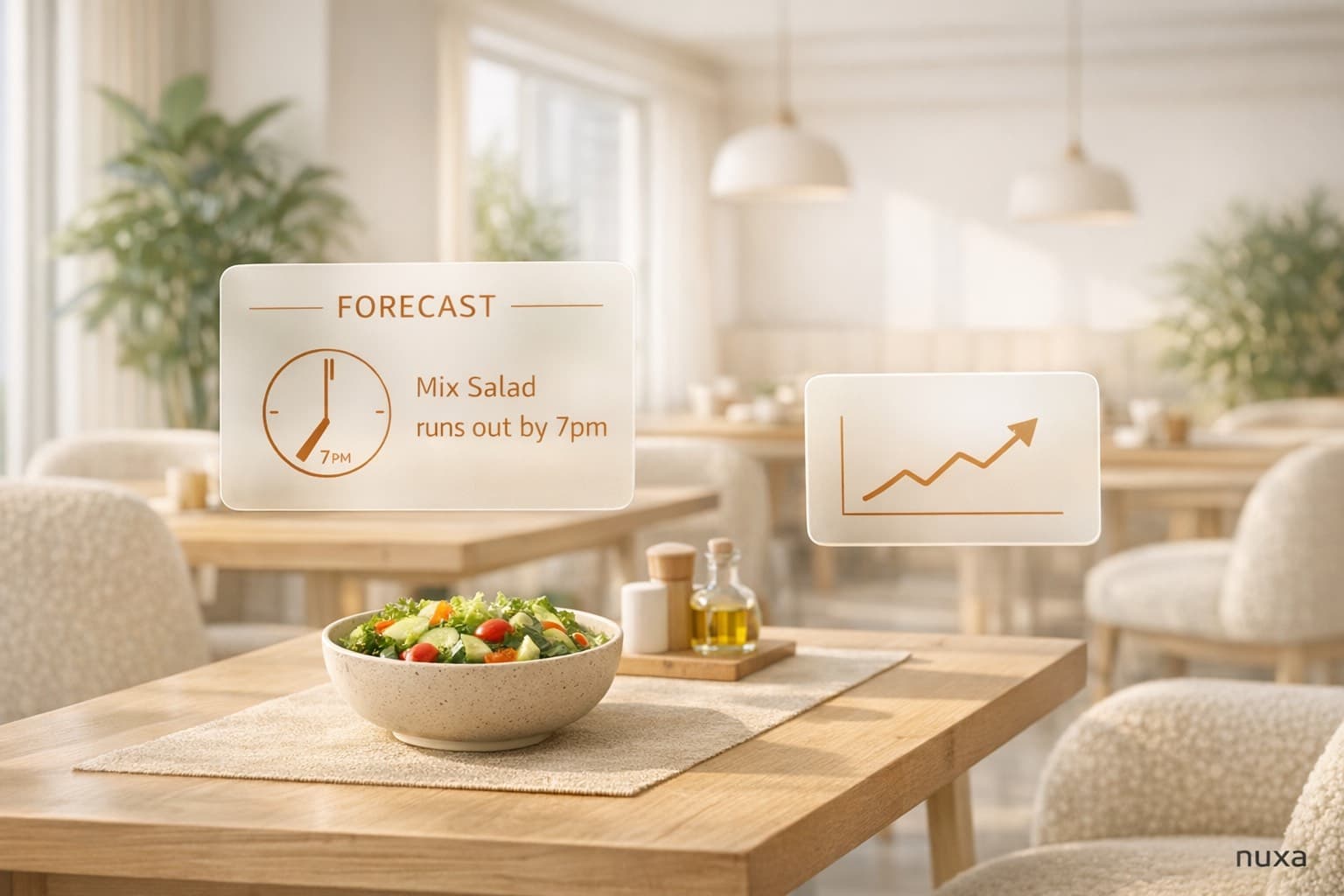
There are two sentences a restaurant system can say to you about Mix Salad, and they sound similar but belong to different universes. The first: "You ran out of Mix Salad at 7pm yesterday." The second: "At today's order rate, you'll run out of Mix Salad by 7pm." The first is a report — accurate, well-formatted, and useless, because the eighty-sixed item already cost you the orders. The second is anticipation, and it arrives while the fix still exists: prep more now, adjust the special, tell the kitchen.
Almost everything sold as "restaurant analytics" lives in the first universe. This post is about what it takes to live in the second — and why most tools structurally can't.
Why do restaurant dashboards keep failing operators?
Not because the numbers are wrong. Because of when they arrive and what they ask of you. A dashboard is a pile of true statements about the past, delivered whenever you find time to look, with the analysis left as an exercise for the owner. By the time "Mix Salad sold out at 7pm" appears on a weekly report, the moment to act on it is four days dead — and the report doesn't even tell you it's the third Friday in a row, unless you go digging.
- Reporting answers: what happened? Anticipation answers: what's about to happen, and what should I do about it?
- Reporting is pull — you have to go look. Anticipation is push — it interrupts you exactly when the window to act is open.
- Reporting scales with your free time, of which a restaurant owner has none. Anticipation scales with the data, of which a restaurant has plenty.
What does it take to predict a 7pm stockout at 3pm?
Less magic than you'd think, but one hard requirement. The math is honest extrapolation: today's order velocity for the item, weighted against the pattern of past comparable days (Fridays look like Fridays, sunny days lift salads, the football match shifts everything an hour), projected against what the kitchen prepped. When the projected sell-out lands inside service hours, you get the sentence — at 3pm, not in next week's PDF.
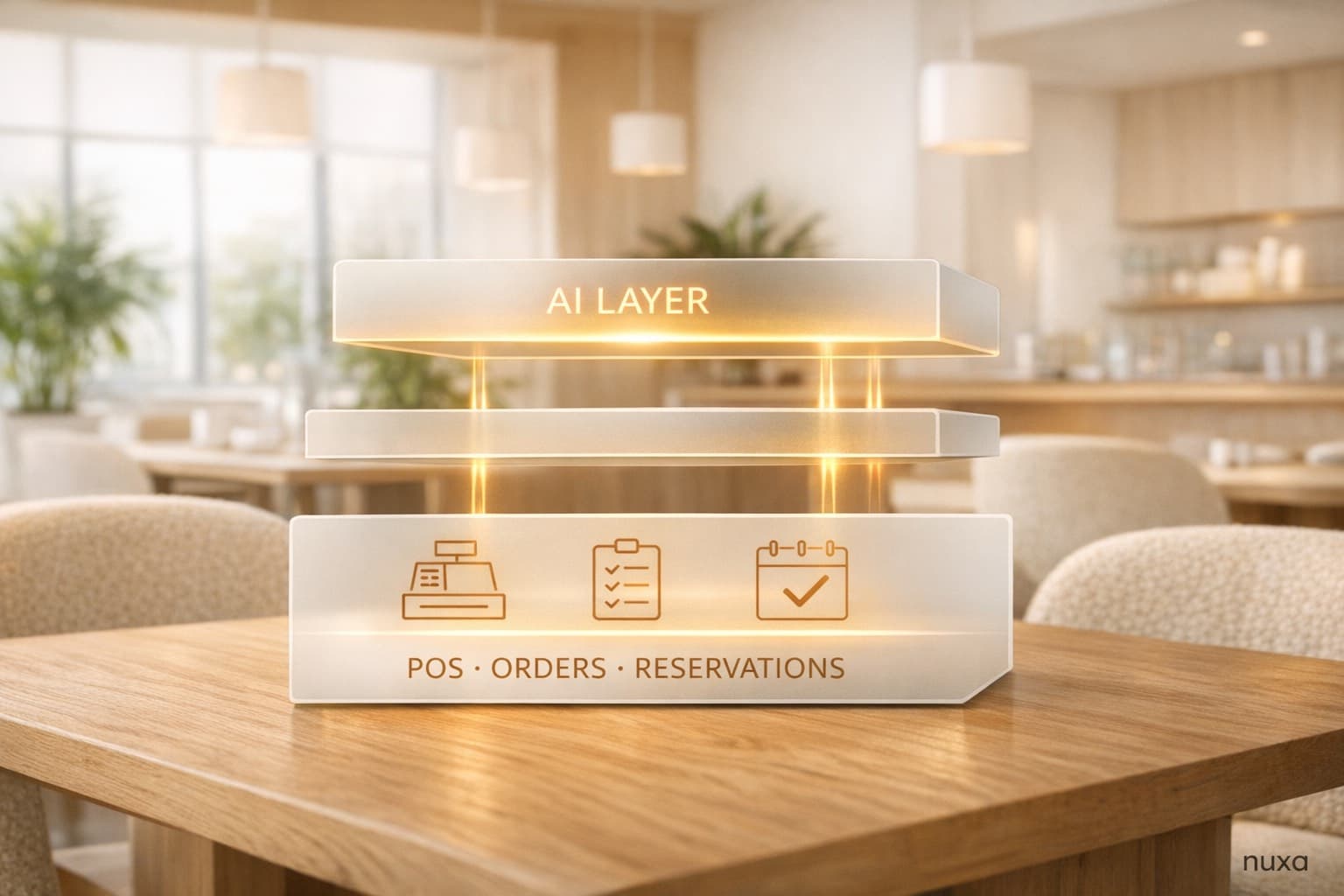
The hard requirement is the data feed. You cannot extrapolate today's order velocity from a nightly export — by definition the export arrives after service. Anticipation needs to watch orders as they fire, which is why Nuxa's version of it exists at all: our AI employees connect to your POS and ordering system, reading the live order stream rather than yesterday's snapshot. The full reasoning behind that architecture is in why we built on a POS (https://nuxa.ai/blog/why-we-built-on-a-pos). Atlas — our anticipation and listings employee — is the one watching the clock.
A prediction without a citation is a vibe. "You'll run out by 7pm" only deserves your trust if you can tap it and see the order data it was computed from.
That tap-to-verify is not optional in Nuxa. Every anticipatory claim follows the same cite-or-die rule as everything else our AI says: the prediction shows its inputs — today's velocity, the comparable days it weighted, the prep count it assumed. If the data can't support the sentence, the sentence doesn't get said. The full trust model is at https://nuxa.ai/trust.
What other anticipations matter beyond stockouts?
- Staffing pressure: "Order volume is tracking 30% above a normal Tuesday — tonight will feel like a Friday" at 4pm, while you can still call someone in.
- Quiet-night warnings: tracking well under baseline by late afternoon is a prompt to act — a same-day social post or a push to your list — instead of a shrug at close. That's where Vibe, our social employee, picks up the handoff.
- Regulars going quiet: visit-cadence decay flagged while the relationship is recoverable, not after. We covered that one in depth in the churn alerts post (https://nuxa.ai/blog/restaurant-churn-alerts-lost-regulars).
- Demand-driven prep: "Last three rainy Wednesdays, soup orders ran 2× — rain forecast tomorrow" the evening before prep, not the morning after the sell-out.
Where do these warnings actually show up?
Two channels, by urgency. Same-day operational calls — the 7pm stockout, the staffing spike — arrive as pushes when the action window is open. Everything with a longer fuse lands in the Daily Brief (https://nuxa.ai/daily-brief), the morning summary Dash assembles: last night's numbers, what needs your approval, and what's coming that you'd want to know about. Anything that would require an action under your restaurant's name still stops at the approval line — anticipation tells you earlier; it never decides for you.
The test to run on any analytics product, including ours: count how many of its sentences are about the future. If the answer is zero, you're buying a rearview mirror with a subscription. The whole point of an AI team — at $299/month, less than a single shift of labor — is that it watches the road ahead while you run the room.