Restaurant owners are professionally suspicious of variable costs, and they should be. You run a business where food cost moves with the market, labor moves with the schedule, and the only thing standing between you and a bad month is knowing your numbers. So when an AI vendor says 'pricing depends on usage,' the correct operator response is the one you'd give a fish supplier who says 'price depends on how hungry your customers are.'
This post opens the books on what AI actually costs to run for a restaurant — the raw model economics, where surprise bills come from, and how metering with a hard ceiling turns AI from a variable cost into a fixed one.
What do the raw AI model calls actually cost?
Less than most owners assume. A modern efficient model handles a review reply draft for well under a cent. A full morning brief — reading the night's orders, comparing against your baselines, ranking what matters, writing the narration — runs a few cents. Across a busy single location running the full AI team, raw model spend typically lands in the range of one to a few dollars per day. That's the honest baseline: the intelligence itself costs about as much as the lemon wedge on a water glass.
So where do surprise AI bills come from?
- Runaway loops. An agent retries a failing task all night, burning tokens at 3am with nobody watching. Without a hard stop, one bug becomes a three-figure line item.
- Per-seat and per-feature creep. The base price covers the demo; replies, posts, and reports each unlock at another $49/month, and the real bill is triple the website price.
- Usage tiers with cliffs. You're fine at 1,000 'AI actions' until a busy December pushes you to 1,001 and the next tier.
- Opaque metering. If you can't see per-call costs, you can't dispute, predict, or budget them. The vendor's meter is the only meter.
None of these are model costs. They're billing-design costs — and they're all preventable with two mechanisms: metering and a ceiling.
How does per-call metering work?
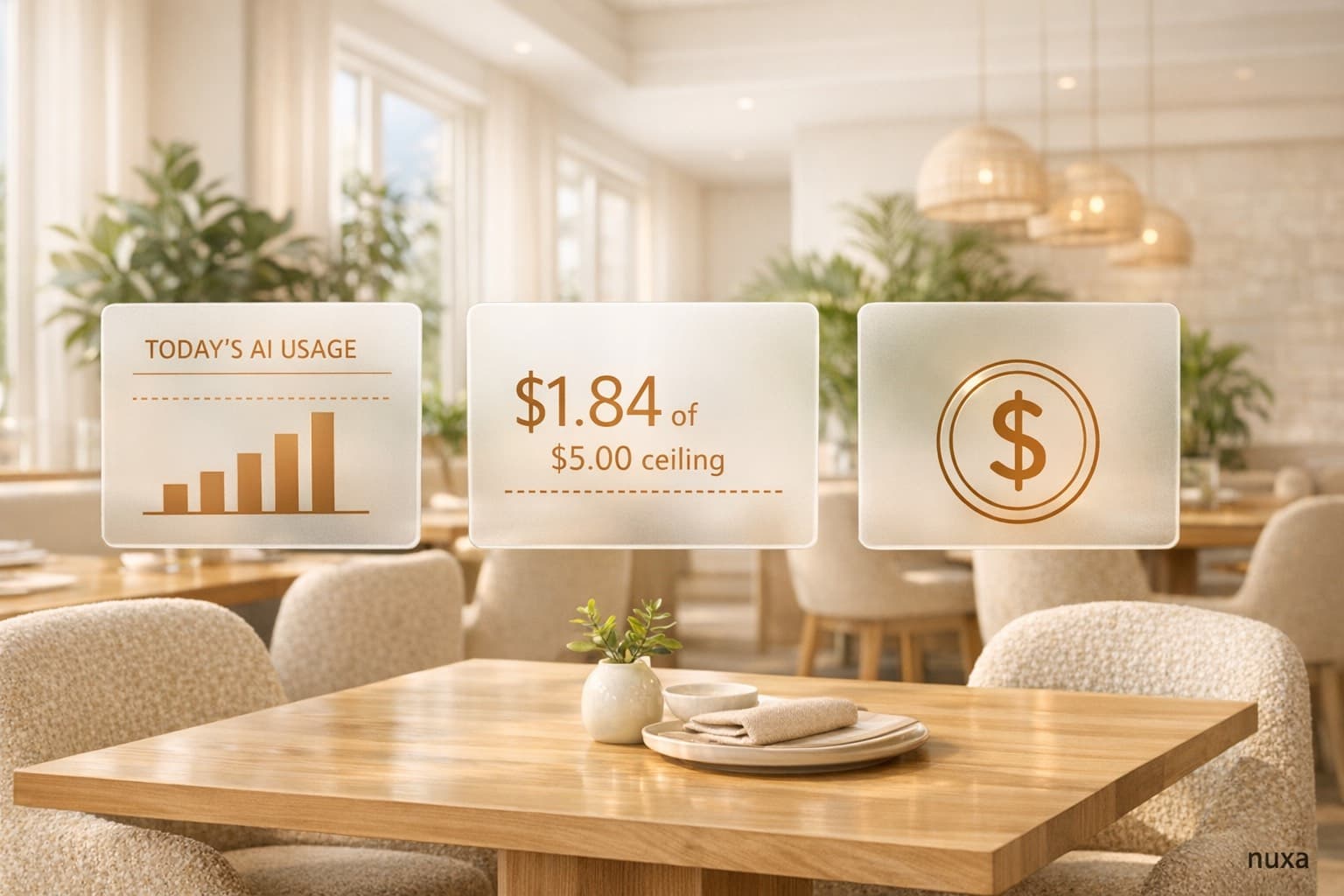
Inside Nuxa, every single model call — every draft, every brief, every processing batch — writes a meter row: which AI employee, which task, which model, and the exact compute consumed, for which location. There are no unmetered calls; a model call that doesn't write a meter row can't ship. Your dashboard rolls this into a live daily spend bar, so 'what is the AI costing me today' has the same one-glance answer as 'what did we sell today.' The same rows feed the audit log, so cost and accountability are one record, not two systems.
What is a hard daily ceiling and why does it matter?
Each location has a daily spending limit. When the day's metered spend hits it, the AI team stops and tells you — a visible notice, not a silent throttle and never a silent overrun. A runaway loop at 3am hits the limit, halts, and surfaces as a notice in your morning brief instead of a horror story on your invoice. The limit is a hard stop in the code, in the same family as our other non-negotiables: like the permanent approval gate on refunds, it doesn't loosen because the system is having a good month.
A budget you can't enforce is a hope. The ceiling turns 'we expect AI to cost about this much' into 'AI cannot cost more than this much.' Owners sleep differently on the second sentence.
Why flat pricing instead of usage pricing?
Because metering plus a ceiling makes our costs predictable, we can make your price flat: $99 per location per month for Site, $299 for Starter, or $499 for the full team — see nuxa.ai/pricing for the exact split. No per-reply fees, no action tiers, no overage line. The metering you see in the dashboard isn't how we bill you; it's how we prove the system is behaving. Usage detail as transparency, flat rate as the deal.
Run the comparison against the status quo: a review-management tool, a social scheduler, a reporting add-on, and a few hours a week of your own screen time across six dashboards. Most owners find the flat fee replaces both the tool stack and the hours — our post at nuxa.ai/blog/stop-checking-six-dashboards walks that math. And if you want to see exactly what a day of AI work costs before you pay for one, the metering bar is on the trust page at nuxa.ai/trust, screenshot and all. The honest answer to 'how much does AI cost per restaurant' is: a few dollars a day to run, $299 a month to never think about it again.